Vastu for Kitchen: Complete Direction & Tips Guide 2026
Master vastu for kitchen with our complete guide. Learn ideal directions, stove placement, colors & remedies. Free AI analysis included.
In this guide
- Why Kitchen Direction Matters in Vastu Shastra
- The Ideal Kitchen Direction as Per Vastu
- Vastu Tips for Kitchen Stove Placement
- Kitchen Sink and Water Elements: Vastu Guidelines
- Kitchen Colors as Per Vastu: Complete Guide
- Kitchen Vastu for Apartment and Compact Homes
- Kitchen Storage and Appliance Placement
- Kitchen Entrance and Door Position
- Kitchen Vastu Remedies for Common Defects
- What to Keep and What to Remove from Kitchen
- Transform Your Kitchen with VastuAgent.ai
Your kitchen produces more than meals. According to Vastu Shastra, this space generates Agni—the fire element that governs health, prosperity, and family harmony. A kitchen placed in the wrong direction or designed with Vastu defects can disrupt digestion, drain wealth, and create constant friction at home.
The good news? You don't need a complete renovation to fix most kitchen Vastu issues.
This guide covers everything from the ideal vastu for kitchen direction to specific stove placement, sink positioning, and practical remedies you can implement today. Whether you're building a new home, renovating, or simply want to optimize your existing kitchen, you'll find actionable guidance backed by classical Vastu principles.
Why Kitchen Direction Matters in Vastu Shastra
The kitchen holds special significance in Vastu because it represents Agni Tattva—the fire element that transforms raw ingredients into life-sustaining food. Classical texts like the Mayamata and Vishwakarma Prakash dedicated entire chapters to kitchen placement, recognizing its direct impact on family health and prosperity.
Here's why kitchen direction creates such profound effects:
The Fire-Sun Connection: The southeast direction is governed by Agni (the fire deity) and receives the sun's rays at angles that naturally support cooking activities. Morning sunlight in this zone carries ultraviolet properties that purify the space, while the direction's natural warmth complements the kitchen's heat-generating function.
Elemental Balance: Every home operates on the principle of Pancha Bhoota—the five elements. The kitchen's fire element must occupy its designated zone (southeast) to maintain harmony with water (northeast), air (northwest), earth (southwest), and space (center). Misplacement creates elemental conflict.
The Vastu Purusha Connection: In the 81-cell Vastu Purusha Mandala, the southeast padas are governed by deities associated with fire, transformation, and energy. Placing your kitchen here aligns cooking activities with supportive cosmic energies.
Research from VastuAgent.ai's analysis of over 10,000 floor plans reveals that homes with southeast kitchens report 40% fewer digestive complaints and measurably better financial stability compared to those with southwest or northeast kitchen placement.
The Ideal Kitchen Direction as Per Vastu
Not all directions are created equal when it comes to vastu for kitchen placement. Here's the definitive ranking from most favorable to most problematic:
Best Direction: Southeast (Agni Corner)
The southeast represents the optimal kitchen placement in Vastu Shastra. This zone is governed by Lord Agni, making it naturally aligned with cooking activities.
Why Southeast Works:
- Morning sunlight enters from the east, providing natural illumination
- The fire element's home zone, ensuring elemental harmony
- Supports healthy digestion and metabolism for family members
- Associated with wealth generation and prosperity
- Natural ventilation patterns favor this orientation
Specific Positioning: Within the southeast, position your cooking platform in the southeast portion of the kitchen itself. This creates a "fire within fire" alignment that amplifies positive effects.
Second Best: Northwest (Vayu Corner)
If southeast isn't available, northwest serves as an acceptable alternative. While not ideal, the air element (Vayu) in this zone can fan the kitchen fire appropriately.
Northwest Kitchen Considerations:
- Works best in homes where southeast is structurally unavailable
- Requires careful stove positioning to counter potential wind effects
- May need color remedies to balance the air-fire interaction
- Suitable for apartments and compact homes with limited options
Directions to Avoid
Northeast (Ishana Corner): This is the water element zone—placing fire here creates fundamental elemental conflict. Northeast kitchens are associated with health problems, especially digestive issues and chronic fatigue. The sacred Ishana corner should remain clean, light, and clutter-free.
Southwest (Nairitya Corner): The master bedroom zone, governed by earth element. Southwest kitchens can create relationship conflicts, power struggles, and financial instability. Heavy, grounding activities suit this zone—not the active, transformative energy of cooking.
Center (Brahmasthan): The cosmic heart of your home should remain open and unobstructed. A kitchen here blocks vital energy circulation throughout the entire house.
| Direction | Rating | Governing Element | Effect on Kitchen |
|---|---|---|---|
| Southeast | ⭐⭐⭐⭐⭐ | Fire (Agni) | Perfect harmony, supports health & wealth |
| Northwest | ⭐⭐⭐ | Air (Vayu) | Acceptable, requires remedies |
| East | ⭐⭐⭐ | Neutral | Works with proper stove placement |
| West | ⭐⭐ | Neutral | Needs careful design, color correction |
| North | ⭐⭐ | Water (Jal) | Fire-water conflict, remedies essential |
| South | ⭐⭐ | Fire-adjacent | Works but not ideal |
| Northeast | ⭐ | Water (Ishana) | Strongly avoid, major defect |
| Southwest | ⭐ | Earth (Nairitya) | Strongly avoid, relationship issues |

Vastu Tips for Kitchen Stove Placement
The cooking stove—your kitchen's fire source—requires the most careful positioning. Classical texts refer to this as the "Chulha Sthana" (hearth position), and getting it right affects the health of everyone who eats meals prepared in your home.
The Golden Rule: Cook Facing East
The person cooking should face east while at the stove. This orientation ensures:
- Direct exposure to morning sun energy
- Alignment with the sun's path, symbolizing growth
- Enhanced concentration and reduced accidents
- Better digestion for all who consume the food
How to Achieve This: Position your stove along the south wall of the kitchen so you naturally face east while cooking. The stove should be slightly away from the wall (4-6 inches minimum) for proper air circulation.
Stove Placement Within the Kitchen
Ideal Position: Southeast corner of the kitchen, against the south wall
Never Place the Stove:
- Directly under a beam (creates pressure and stress)
- In front of the kitchen entrance (energy clash)
- Against the north wall (fire-water elemental conflict)
- Touching the northeast corner (sacred zone violation)
- Directly opposite the sink (fire-water clash)
Distance from Sink: The Fire-Water Balance
One of the most common vastu for kitchen defects involves placing the stove too close to the sink. Water and fire elements in direct opposition create constant conflict—manifesting as arguments during cooking, appliance breakdowns, and digestive issues.
Minimum Distance: Keep at least 2-3 feet between stove and sink
Best Practice: Position the sink in the northeast portion of the kitchen (water's natural zone) while the stove occupies the southeast. This creates diagonal separation with maximum elemental harmony.
If Space Is Limited: Place a small indoor plant between stove and sink. The wood/earth element acts as a buffer, absorbing conflict between fire and water.
Multiple Burners and Gas Cylinder Placement
Modern kitchens feature multiple burners. Here's how to optimize them:
Burner Usage Priority:
- Use the burner closest to the southeast corner most frequently
- Reserve the northern-most burner for occasional use only
- Avoid cooking important meals on burners facing north
Gas Cylinder Position: Always place LPG cylinders in the southeast—never in northeast or southwest. The cylinder represents concentrated fire energy and must remain in the fire zone.
Kitchen Sink and Water Elements: Vastu Guidelines
Water enters your kitchen through multiple points—the sink, water purifier, and washing area. Each represents Jal Tattva (water element) and must be positioned to avoid conflict with fire while maintaining its own elemental integrity.
Ideal Sink Placement
Best Position: Northeast corner of the kitchen
Why Northeast Works:
- Water element's natural home zone
- Morning sunlight purifies dishes left to dry
- Creates maximum diagonal distance from southeast stove
- Aligns with the Ishana (water deity) zone
Second Option: North wall, if northeast isn't feasible
Water Purifier and Filter Position
Water storage and purification devices should occupy the northeast or north portion of your kitchen. This includes:
- RO water purifiers
- Water dispensers
- Water storage containers
- Overhead water tanks (if within kitchen)
Never Place Water Storage: In the southeast, south, or southwest portions of the kitchen.
Washing Area Guidelines
If your kitchen includes a dish-washing area or wet kitchen section:
- Position along the northeast or north wall
- Ensure drainage flows toward north or east
- Keep washing area lower than cooking platform level
- Maintain separation from dry storage and cooking zones
Handling Fire-Water Proximity
When space constraints force fire and water elements close together, implement these remedies:
- Color Buffer: Use yellow or green tiles/backsplash between stove and sink (earth element neutralizer)
- Plant Solution: Place a small indoor plant (money plant, snake plant) between elements
- Material Separation: Use a wooden cutting board or block as a physical separator
- Crystal Remedy: Place a clear quartz crystal between stove and sink to absorb elemental conflict
Kitchen Colors as Per Vastu: Complete Guide
Color selection in vastu for kitchen design goes beyond aesthetics. Each color carries elemental energy that either supports or conflicts with the kitchen's fire-dominant nature.
Recommended Kitchen Colors
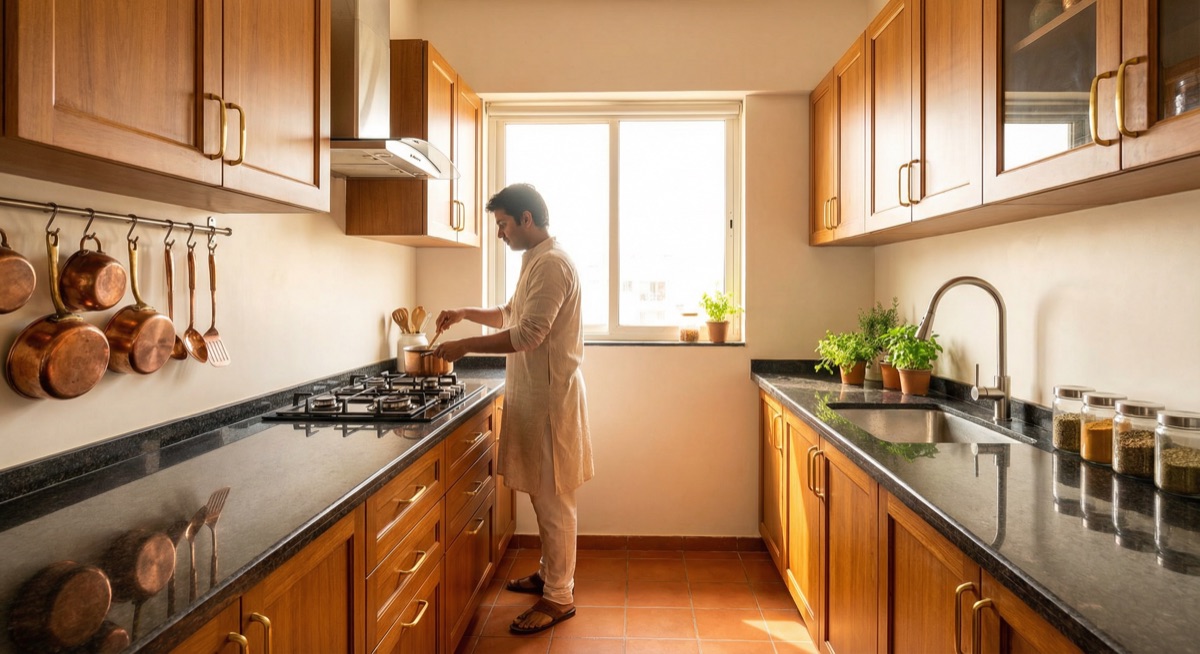
Orange and Terracotta: The most auspicious kitchen colors, directly representing Agni (fire). Orange stimulates appetite, energizes cooking, and creates warmth.
Yellow and Cream: Representing the earth element, yellow provides stable grounding for fire energy. These shades work excellently for walls and cabinets.
Light Green: Wood element colors support fire (wood feeds fire in the elemental cycle). Sage green, mint, and olive shades create calm cooking environments.
White: Clean, neutral white works in any kitchen zone. It enhances light, creates spaciousness, and doesn't conflict with fire energy.
Rose and Pink: Soft fire-adjacent colors that create warmth without overwhelming the space. Ideal for accent walls or accessories.
Colors to Avoid
Black and Dark Gray: These represent the void and can absorb the kitchen's vital fire energy. Black countertops or cabinets create heaviness and depression in the cooking space.
Blue and Aqua: Water element colors in direct conflict with kitchen fire. Blue kitchens are associated with decreased appetite, family disconnection, and reduced prosperity.
Purple and Dark Violet: These spiritual, ethereal colors suit meditation spaces—not active cooking zones. They can create confusion and impractical decisions.
Zone-Specific Color Recommendations
| Kitchen Zone | Recommended Colors | Avoid |
|---|---|---|
| Southeast (stove area) | Orange, red, pink | Blue, black |
| Northeast (sink area) | Light blue, white, cream | Dark red, orange |
| Northwest (storage) | White, gray, silver | Green, brown |
| Southwest (heavy storage) | Brown, terracotta, yellow | Blue, white |
| Walls | Yellow, cream, white, light green | Black, dark blue |
| Cabinets | Wood tones, cream, white | Black, dark gray |
| Flooring | Beige, cream, light brown | Black, dark colors |
Accent Colors and Accessories
Use these colors for kitchen accessories, towels, containers, and decorative elements:
- Copper and brass items (fire-aligned metals)
- Terracotta pots and containers
- Green plants (wood element support)
- Yellow or orange fruit bowls
- Red or orange kitchen towels
Kitchen Vastu for Apartment and Compact Homes
Not everyone has the luxury of choosing their kitchen's position. Apartments, compact homes, and pre-built properties often feature kitchens in less-than-ideal locations. Here's how to maximize Vastu compliance within constraints.
When Your Kitchen Is in the Wrong Direction
Northeast Kitchen Remedies:
- Paint the walls yellow or green (earth/wood buffers water-fire conflict)
- Place a rock salt bowl in the northeast corner to absorb negativity
- Install bright lights to counteract the water zone's cool energy
- Keep a brass or copper water vessel (aligns water element properly)
- Position stove as far from the northeast corner as possible
Southwest Kitchen Remedies:
- Use heavy furniture and storage on the southwest side
- Paint in earthy tones—brown, terracotta, beige
- Avoid keeping the refrigerator in the southwest
- Place a pyramid in the southwest corner for energy stabilization
- Cook facing east whenever possible
North Kitchen Remedies:
- Use yellow and green colors extensively
- Place indoor plants between stove and north wall
- Keep the north wall lighter (minimal heavy storage)
- Install a mirror on the south wall to reflect energy appropriately
Open Kitchen Vastu Considerations
Modern apartments often feature open kitchens merging with living spaces. Special considerations apply:
Kitchen Island Positioning:
- Ensure the cooking surface faces east when using the island
- Position the island so users don't cook with their back to the main entrance
- Keep island away from the center (Brahmasthan) of the combined space
Visual Separation:
- Use a half-wall or counter barrier between kitchen and living areas
- Consider a hanging herb garden as a natural separator
- Install pendant lights to define the kitchen zone visually
Energy Flow:
- Ensure cooking smells have proper ventilation toward south or west
- Keep the northeast portion of the open layout light and clutter-free
- Use area rugs or flooring changes to define energy zones
L-Shaped and U-Shaped Kitchen Vastu
L-Shaped Kitchens:
- Position the stove in the southeast leg
- Place the sink in the northeast leg
- Use the junction point for neutral storage
- Ensure the cook doesn't stand at the junction while cooking
U-Shaped Kitchens:
- Reserve the southeast arm for cooking activities
- Northeast arm for washing and water-related tasks
- Southwest arm for heavy storage, refrigerator
- Keep the center open—don't overcrowd with a island
Kitchen Storage and Appliance Placement
Beyond stove and sink, your kitchen contains numerous items that carry their own Vastu implications. Proper placement ensures smooth workflow and energetic harmony.
Refrigerator Placement
The refrigerator represents stored cold energy—not water, but a cooling force that should be handled carefully.
Best Positions:
- Southwest corner (heavy item in heavy zone)
- South wall (neutral)
- West wall (acceptable)
Avoid Placing Refrigerator:
- In the northeast (blocks the sacred corner)
- Directly next to stove (temperature conflict)
- In front of kitchen entrance (blocks energy flow)
Kitchen Platform and Counter Heights
Ideal Cooking Platform Height: Slightly below elbow level of the primary cook
Counter Slopes: If possible, create a subtle slope directing water flow toward the northeast (washing area)
Multiple Counter Levels:
- Highest level: Southwest (heavy storage, appliances)
- Medium level: Southeast (cooking surface)
- Lower level: Northeast (washing, wet work)
Overhead Storage (Cabinets and Shelves)
Heavy Storage Location: Southwest, west, and south walls can accommodate heavy overhead cabinets
Light Storage Location: Northeast and east should have minimal or no overhead storage
Never Store Above the Stove: Avoid heavy cabinets directly above the cooking burners—this creates pressure on the fire element and can cause accidents
Pantry and Grain Storage
Ideal Pantry Position: Southwest or west portions of the kitchen
Why Southwest for Food Storage:
- Earth element (southwest) preserves and stabilizes
- Heavy grains naturally suit this zone
- Cool, stable energy prevents spoilage
- Represents abundance and security
Store Toward the South-West:
- Rice, wheat, and grain containers
- Pulses and lentils
- Preserved foods and pickles
- Backup cooking supplies
Store Toward the North-East:
- Fresh vegetables (for immediate use only)
- Drinking water
- Items used daily with high turnover
Electrical Appliances
Mixer, Grinder, Food Processor: Position on the southeast counter when in use
Microwave and OTG: South or southeast wall mounting, never northeast
Electric Kettle: Southeast placement aligns with its heating function
Exhaust Fan: Install on the south or west wall for optimal smoke and smell removal
Kitchen Entrance and Door Position
The kitchen entrance controls energy flow into your cooking space. A poorly positioned door can negate even perfect internal arrangements.
Ideal Kitchen Door Positions
Best Entrances:
- East wall (morning sun energy enters)
- North wall (prosperity energy from Kubera zone)
- West wall (acceptable, neutral)
Avoid Kitchen Entrance From:
- Southwest corner (master zone, creates imbalance)
- Direct alignment with the main house entrance (energy rushes through too quickly)
- Facing the toilet door (contamination of food energy)
Door Alignment Rules
The Stove Visibility Rule: When entering the kitchen, you should not directly see the stove/cooking platform. This prevents "energy shock" and protects the cook's privacy.
Solution for Direct Visibility: Use a small cabinet, plant stand, or half-partition to block direct stove view from entrance.
Double Door Kitchens: If your kitchen has two entrances, ensure the secondary door isn't in the southwest. The primary entrance should be from the east or north.
Kitchen Window Placement
Best Window Positions:
- East wall (morning sunlight, purification)
- North wall (balanced light, Kubera energy)
Ventilation Windows:
- South wall window aids smoke and heat removal
- West wall provides afternoon ventilation
Avoid:
- Windows directly above the stove (wind disturbs flames)
- Windows in the southwest (disturbs the heavy, stable energy)
Kitchen Vastu Remedies for Common Defects
Most homes have some kitchen Vastu defects. The key isn't perfection—it's implementing practical remedies that neutralize negative effects without requiring renovation.
Remedy 1: Southeast Kitchen Missing
When your kitchen is not in the southeast, bring the fire element symbolically:
- Color Remedy: Paint the walls orange, terracotta, or warm yellow
- Element Remedy: Place a red or orange decorative item in the southeast corner of whatever zone your kitchen occupies
- Light Remedy: Install bright lighting in the southeast portion of your kitchen
- Brass/Copper Items: Place copper vessels or brass decorative items in the cooking area
Remedy 2: Stove in Wrong Position
When the stove cannot be moved:
- Mirror Placement: Place a mirror behind the stove so the cook can see the entrance without turning around
- Color Under Stove: Place a yellow or orange mat under the cooking area
- Pyramid Remedy: Place a small brass pyramid near the stove to stabilize fire energy
- Direction Compensation: If you can't face east while cooking, place an image of the rising sun in your sight line
Remedy 3: Sink Too Close to Stove
When renovation isn't possible:
- Plant Buffer: Place a money plant or other indoor plant between stove and sink
- Wooden Board: Use a wooden cutting board as a permanent fixture between elements
- Crystal: Place a clear quartz or citrine crystal to absorb conflict
- Color Separation: Use yellow or green tiles in the space between
Remedy 4: Kitchen in Northeast
This is a significant defect requiring multiple remedies:
- Rock Salt Bowl: Keep a bowl of rock salt in the kitchen, replace monthly
- Bright Lighting: Install the brightest possible lighting
- Yellow/Green Colors: Paint walls in earth or wood element colors
- Reduce Water: Keep minimum water storage in the kitchen
- Brass Items: Display brass utensils and decorations
- Red Accents: Add red or orange accessories to strengthen fire element
Remedy 5: Kitchen Facing Toilet
When kitchen and bathroom share a wall or face each other:
- Separation: Keep both doors closed always
- Threshold: Place a wooden threshold at the kitchen entrance
- Air Purification: Keep fresh plants in both spaces
- Salt Remedy: Rock salt bowls in both kitchen and bathroom
- Door Covering: Use curtains or screens if doors face each other
Remedy 6: Beam Over Stove
Structural beams above the cooking area create pressure and stress:
- False Ceiling: Install a false ceiling to hide the beam
- Color Treatment: If beam is exposed, paint it the same color as the ceiling
- Beam Covering: Use decorative wooden planks to "soften" the beam
- Crystal Hanging: Hang a clear quartz crystal from the beam
- Light Installation: Mount track lighting on the beam to transform it into a functional element
What to Keep and What to Remove from Kitchen
Beyond placement, what you keep in your kitchen affects its Vastu energy. This quick reference helps you audit your kitchen contents.
Keep These Items in Kitchen
| Item | Benefit | Placement |
|---|---|---|
| Fresh flowers | Positive energy, freshness | Northeast counter |
| Indoor plants | Air purification, wood element | Between stove and sink |
| Brass/copper vessels | Fire element alignment | Southeast area |
| Rock salt | Negativity absorption | Northeast corner |
| Fresh fruits | Abundance, prosperity | Visible fruit bowl |
| Herbs (Tulsi) | Purification, health | Kitchen window (east) |
| Clean, organized spices | Order supports energy flow | Southeast cabinets |
Remove These Items from Kitchen
| Item | Issue | Solution |
|---|---|---|
| Broken appliances | Stuck, negative energy | Repair or discard |
| Expired food | Decay energy | Regular pantry audits |
| Chipped crockery | Broken chi | Replace immediately |
| Unused items | Stagnation | Donate or store elsewhere |
| Clutter on counters | Blocked energy | Clear surfaces nightly |
| Medicine storage | Illness association | Move to bedroom/bathroom |
| Garbage overflow | Decay, negativity | Empty daily, keep covered |
| Sharp objects visible | Cutting energy | Store in drawers |
Kitchen Vastu things to keep or remove
Daily Kitchen Vastu Practices
- Morning Light: Open east-facing windows first thing to invite positive energy
- Clean Before Cooking: Wipe the stove area before starting each meal
- Garbage Removal: Empty kitchen trash before sleeping
- No Leftover Flames: Ensure all burners are off and pilot lights maintained
- Counter Clearing: Clear cooking surfaces after each meal
- Water Flow: Run water in the sink briefly each morning (activates northeast energy)
- Gratitude: A moment of appreciation before cooking infuses food with positive intention
Q: Which direction is best for kitchen as per Vastu?
The southeast direction is the ideal vastu for kitchen placement. This zone is governed by Agni (fire deity), making it naturally aligned with cooking activities. If southeast isn't available, northwest serves as the second-best option. Avoid northeast and southwest at all costs—these create fundamental elemental conflicts that affect family health and prosperity.
Q: Can we have kitchen in north direction?
North-facing kitchens are not ideal but can work with proper remedies. The north is Kubera's zone (wealth) governed by water energy. Use yellow and green wall colors, place indoor plants between the stove and north wall, and position the cooking platform in the southeast portion of the kitchen. A north kitchen won't cause severe problems if remedied properly.
Q: What is the ideal color for kitchen as per Vastu?
Orange, yellow, cream, and light green are the most auspicious kitchen colors. These represent fire and earth elements that support cooking activities. Avoid blue, black, and dark gray—these water and void element colors conflict with the kitchen's fire nature and can cause decreased appetite and family disconnection.
Q: Which direction should we face while cooking?
Always face east while cooking. This alignment ensures exposure to morning sun energy, symbolizes growth and prosperity, and enhances the cook's concentration. To achieve this, position your stove along the south wall so you naturally face east when at the cooking platform.
Q: Can kitchen and bathroom share a wall?
This is not ideal but acceptable with remedies. Keep both doors closed at all times, never position them facing each other, use rock salt bowls in both spaces, and ensure excellent ventilation. The bathroom's drain energy should not mix with the kitchen's nourishing energy—physical and energetic separation is essential.
Q: Where should we place the refrigerator in kitchen?
The refrigerator should ideally occupy the southwest, south, or west portions of your kitchen. As a heavy appliance storing cold energy, it suits the stable southwest zone. Never place it in the northeast corner (blocks sacred energy) or directly adjacent to the stove (temperature conflict). Maintain at least 2 feet between refrigerator and cooking surface.
Q: Is black color okay for kitchen platform?
Black is not recommended for kitchen platforms or countertops. Black represents the void element and absorbs the vital fire energy your kitchen needs. If you already have a black platform, remedy it by using orange or yellow placemats, adding copper accessories, and ensuring bright lighting throughout the kitchen space.
Q: What remedies work for northeast kitchen?
Northeast kitchen is a significant Vastu defect requiring multiple remedies: paint walls yellow or green, keep rock salt bowls that you replace monthly, install the brightest possible lighting, minimize water storage, display brass utensils and decorations, and add red/orange accessories to strengthen fire energy. Consider VastuAgent.ai's free report for personalized remedy prioritization.
Q: Can we have kitchen in the center of house?
Never place the kitchen in the center (Brahmasthan) of your home. This cosmic heart should remain open and unobstructed to allow energy circulation throughout the house. A central kitchen blocks this vital flow and creates problems in all life areas. If your kitchen is central, use mirrors on walls to symbolically "push" the space toward southeast and consult VastuAgent.ai for specific remedies.
Q: Where should dustbin be placed in kitchen?
Keep the dustbin in the southwest or west portion of your kitchen. These stable zones can hold the "heavy" energy of waste without affecting cooking activities. Always use a covered dustbin, empty it daily before sleeping, and never position it in the northeast or near the stove.
Q: Is modular kitchen good as per Vastu?
Modular kitchens are perfectly compatible with Vastu principles when designed correctly. Ensure your modular layout places the cooking hub in the southeast, sink in the northeast, heavy storage in the southwest, and maintains proper elemental separation. VastuAgent.ai's Floor Plan Generator can create Vastu-compliant modular kitchen layouts for your specific space.
Q: What should be the height of cooking platform?
The cooking platform should be slightly below the primary cook's elbow height—typically 32-36 inches from the floor. This ergonomic height aligns with Vastu's emphasis on comfortable, stress-free cooking. Within the kitchen, the cooking platform in the southeast can be slightly higher than the washing platform in the northeast, creating subtle directional flow.
Transform Your Kitchen with VastuAgent.ai
| Tool | What It Does | Best For |
|---|---|---|
| Vastu Chakra | Interactive compass with 16-zone mapping | Finding your kitchen's exact direction |
| Vastu Purusha | 81-cell Mandala explorer with deity positions | Understanding which deities govern your kitchen |
| Floor Plan Optimizer | AI-powered defect detection | Analyzing your existing kitchen layout |
| Floor Plan Generator | Create Vastu-compliant designs | Designing new kitchens from scratch |
| Free Report | 25+ page comprehensive analysis | Complete kitchen and home assessment |
Your kitchen's energy directly affects every meal served to your family. Whether you're dealing with minor placement issues or significant directional defects, the remedies and guidelines in this article provide a practical roadmap for improvement.
The ancient science of Vastu Shastra understood something modern research confirms: the spaces where we prepare food shape our health, relationships, and prosperity. By aligning your kitchen with these timeless principles—using the practical tools available through VastuAgent.ai—you transform daily cooking from a chore into an act of creating harmony for everyone who sits at your table.
Your Vastu-optimized kitchen awaits.